A hit and run accident is a uniquely traumatic experience — not only because of the physical injuries sustained but because the driver responsible for those injuries deliberately fled the scene, leaving you without the immediate identification and insurance information that standard accidents provide. The absence of an identified at-fault driver creates legal and insurance challenges that standard car accident cases do not present — requiring a lawyer who understands the specific evidence sources, insurance mechanisms, and investigative strategies available when a responsible driver has fled. The good news is that hit and run victims have more legal options than many initially realise. Before you hire a hit and run lawyer, ask these ten essential questions.
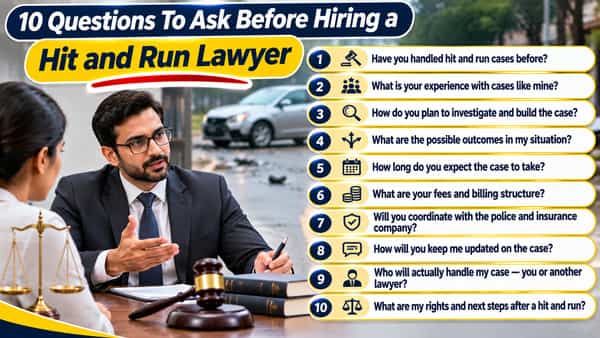
Do you specifically handle hit and run accident cases?
Hit and run cases require knowledge of uninsured motorist coverage law, hit and run investigation techniques, witness and surveillance evidence gathering strategies, and the specific procedural requirements — including police reporting obligations and insurance notification deadlines — that affect claim viability. Ask how many hit and run cases the attorney has handled and what their record of recovery for hit and run victims looks like. A lawyer who regularly handles these cases will know every available avenue for compensation even when the responsible driver is never identified.
What are my legal options if the hit and run driver is never found?
Many people assume that an unidentified driver means no compensation — this is incorrect. Uninsured motorist coverage under your own automobile insurance policy is specifically designed to compensate hit and run victims when the responsible driver cannot be identified. Additionally, third-party liability may exist if a vehicle defect, road design failure, or another driver’s conduct contributed to the accident. Ask the lawyer to identify every potential compensation source in your specific situation and how to pursue each one effectively regardless of whether the fleeing driver is ever identified.
How do you investigate hit and run accidents to identify the responsible driver?
Identifying a hit and run driver — while not always possible — significantly strengthens a victim’s legal position and opens additional compensation avenues. Ask what investigative resources the lawyer deploys — surveillance footage from traffic cameras, business security systems, and residential doorbell cameras, paint transfer and vehicle debris analysis, witness canvassing, social media monitoring for vehicle damage reports, and law enforcement follow-up coordination. A lawyer who actively investigates rather than passively waiting for police results produces better outcomes for hit and run clients.
What documentation must I provide and what deadlines apply to my claim?
Hit and run claims have specific procedural requirements — most states require that victims report hit and run accidents to police within a specified timeframe as a condition of uninsured motorist coverage eligibility, and insurance policies impose their own notification deadlines that must be strictly observed. Ask the lawyer what documentation you need to provide immediately — the police report, witness information, photographs, medical records — and what deadlines apply to protect your claim rights. Missing these requirements can jeopardise your ability to recover compensation entirely.
How does uninsured motorist coverage work in a hit and run claim?
Uninsured motorist coverage is the primary insurance mechanism for hit and run victims — providing compensation for injuries caused by drivers who cannot be identified or who lack insurance. Ask the lawyer to explain your specific UM coverage limits, how UM claims are processed, whether your insurer will require physical contact between vehicles as a condition of coverage, and how they negotiate with your own insurance company when it disputes the claim or attempts to minimise the compensation paid. Dealing with your own insurer as an adversary requires a lawyer who understands UM coverage litigation.
What damages can I recover in a hit and run accident claim?
Hit and run damages follow the standard personal injury framework — all current and future medical expenses, lost wages, lost earning capacity for serious injuries, pain and suffering, emotional distress, and property damage. Ask the lawyer to walk through every applicable damage category for your specific injuries and identify any caps or limitations that apply under your UM coverage policy or state law. Understanding the full scope of recoverable damages helps you evaluate whether any settlement offer genuinely reflects your complete losses.
Can the hit and run driver face additional penalties if identified?
When a hit and run driver is identified, they face both criminal charges — typically a misdemeanour or felony depending on injury severity — and civil liability for your injuries. Their criminal conduct may also support punitive damages in the civil case. Ask how the lawyer coordinates the civil claim with any criminal prosecution of the identified driver, how they use criminal evidence including guilty pleas and convictions to strengthen the civil claim, and whether the driver’s flight from the scene supports additional civil damages beyond the underlying injury claim.
What evidence is most critical to preserve immediately after a hit and run?
Physical evidence from a hit and run accident disappears rapidly — paint transfer on your vehicle, debris from the fleeing vehicle, skid marks, and the accident scene itself all deteriorate quickly. Ask what immediate evidence preservation steps the lawyer recommends — specifically whether to contact law enforcement immediately, how to document the scene with photographs before vehicles are moved, and what steps to take to identify potential witness and camera evidence sources in the immediate vicinity before they become unavailable.
How do you handle insurance companies that dispute hit and run claims?
Insurance companies sometimes challenge hit and run claims — arguing that the accident did not actually involve another vehicle, that physical contact did not occur as required by policy terms, or that the victim’s damages are exaggerated. Ask how the lawyer has countered these arguments in past cases, what evidence strategies they use to establish the hit and run circumstances, and whether they have experience litigating UM coverage disputes when insurers act in bad faith by unreasonably denying valid claims.
What is a realistic assessment of my case’s value and timeline?
Ask the lawyer for an honest, evidence-based assessment of your case’s realistic value given the available compensation sources, the severity of your injuries, and the strength of the evidence. Hit and run cases resolved through UM coverage may have lower total compensation potential than cases with clearly identified at-fault defendants — understanding this honestly from the outset helps you make informed decisions. Ask also about the realistic timeline from claim filing to resolution for cases similar to yours.
FAQs — Hiring a Hit and Run Lawyer
Q1. What should I do immediately after a hit and run accident?
A. Call police immediately, document the scene with photographs, write down everything you remember about the fleeing vehicle, identify witnesses, and notify your insurance company promptly. Early police reporting is often required as a condition of uninsured motorist coverage eligibility.
Q2. Can I still recover compensation if I have no uninsured motorist coverage?
A. Potentially yes — if the hit and run driver is later identified, their insurance or personal assets provide recovery. Some states also have uncompensated injury funds for accident victims without applicable insurance coverage. A lawyer will identify every available source.
Q3. Does my health insurance affect my hit and run compensation claim?
A. Yes — health insurance benefits paid for your treatment may create subrogation rights requiring partial reimbursement from your recovery. A lawyer negotiates these liens to maximise your net compensation from the total recovery.
Q4. What if a hit and run driver is identified weeks after the accident?
A. You can still pursue civil claims against the identified driver — the statute of limitations runs from the accident date, not the date of identification. A lawyer will assess whether the identified driver’s insurance or assets provide meaningful additional recovery beyond your UM coverage.
Q5. Can passengers in a hit and run vehicle make uninsured motorist claims?
A. Yes — passengers injured in a hit and run typically have UM coverage claims available through the vehicle owner’s policy, their own auto insurance policy, and potentially through household family member policies depending on the state’s coverage stacking rules.